Technology & Market
Our products are largely based on novel, patented "chitosan complexes" which enable a variety of industrial applications.
Raw material chitin
Chitin (Greek χιτών chitón, German 'cover, shell') is, alongside cellulose, the most widely distributed biomolecule. It serves structural purposes. Chitin is, like cellulose, a polysaccharide. It occurs in both fungi and arthropods (Articulata) and molluscs. In fungi, it forms one of the main components of the cell wall.
Traditional manufacturing process
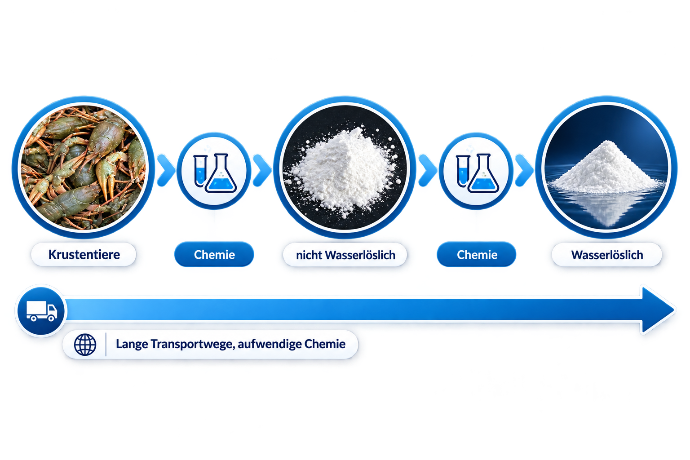
Chitosan is typically produced by deacetylating the chitin shells of shrimp and other crustaceans with an alkali, a complex process involving various (environmentally harmful) chemicals. As the majority of chitosan comes from China, there is also a risk in the supply chain.
Alternative, innovative extraction process
We can currently source chitosan from three different raw material sources:
1. Chitosan from food waste of crustaceans
Hierbei können aufgrund der langen Lieferketten Engpässe in der Verfügbarkeit auftreten.
2. Chitosan from waste of insect farms
Die Ausgangsstoffe stammen aus tierischen Quellen und sind nur begrenzt verfügbar.
3. Chitosan from specially developed fungi (preferred variant)
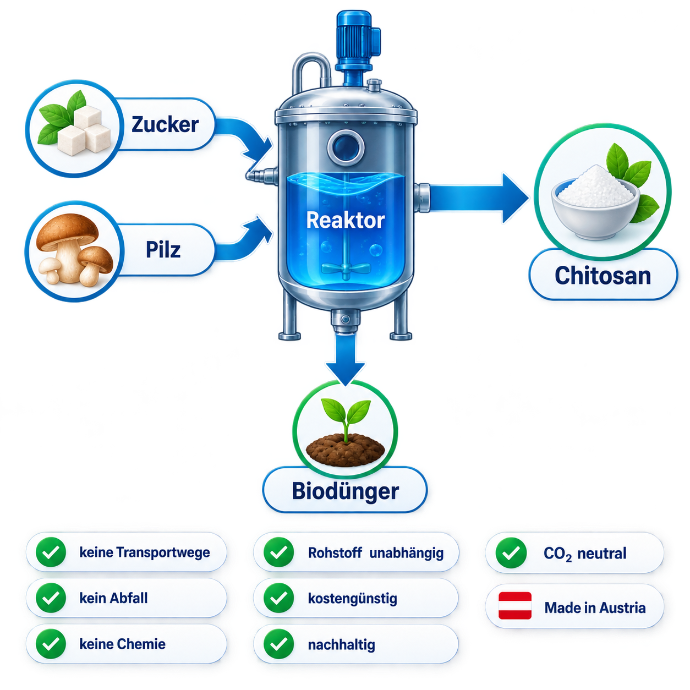
In recent years, a method for producing chitosan from mushrooms has been developed, which is available to us. This is done using fermentation technology. The main advantage of this method over the conventional state of the art is that no chemicals need to be used for deacetylation and this raw material is produced as a result of a simple distillation process. The production can largely be automated, so that the location or labour costs do not play a decisive role. In terms of production costs, the method is absolutely competitive (including the elimination of chemicals, transport costs, and seller margins).
Spectrum of applications from a technological perspective
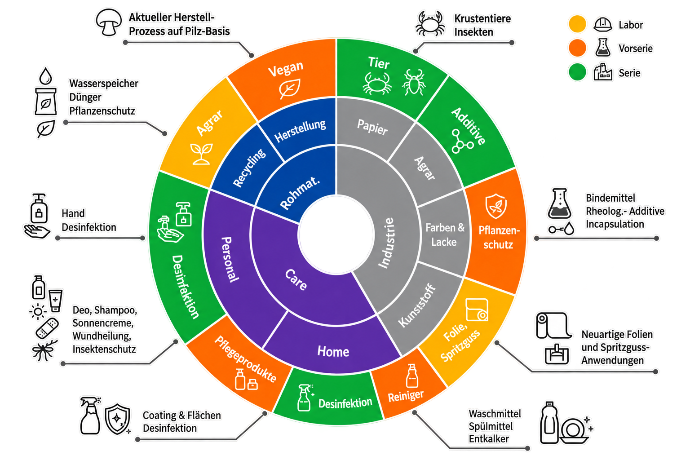
As a result of these novel chitosan complexes, there is an unlimited number of industrial applications. Part of this has been developed in the last 4 years in cooperation with academic institutions and industrial partners. Overview of raw materials/production (blue segments) and applications (industry segments grey and care purple) including a listing of strategic partners and maturity level (see colour or legend):